.avif)

.avif)
AI Book Burning: What Temperature Tells the Truth?

If the AI companies do not want to be seen as evil, they should not undertake secret projects that, when revealed in a court of law, remind the public of some of the worst atrocities in our recent history.
Like book burning.
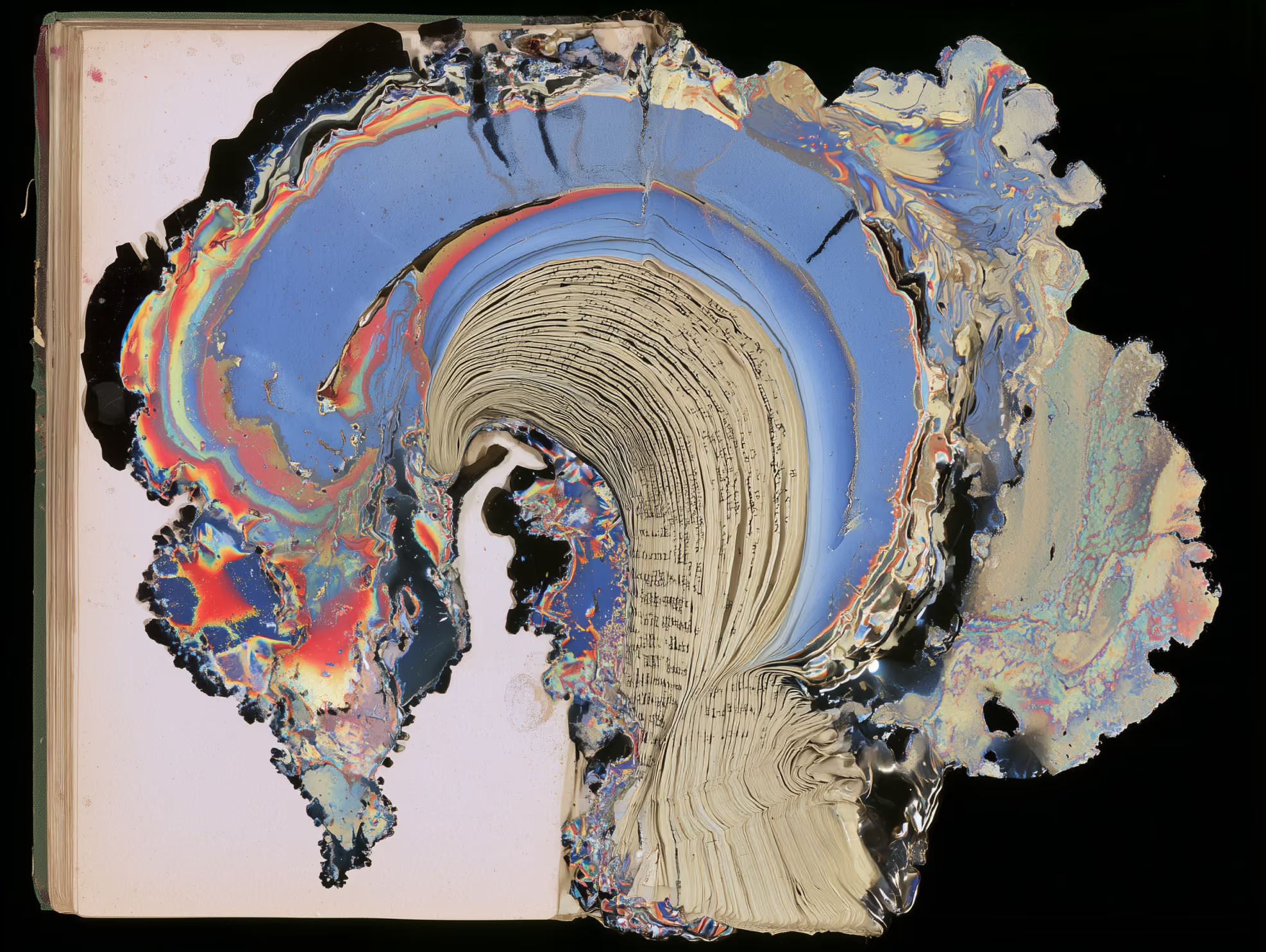
That quote is from one of Anthropic’s internal planning documents, unsealed in legal filings and revealed in The Washington Post's January reporting. It makes it extremely clear that the company knew they needed “clean” data to train their models on — meaning human language uncompromised by (ironically) the very LLMs they’re training or “low quality internet speak” as one co-founder put it — and they also knew it would not be a good look for them to be seen buying up books to train their models on, then destroying them.
We should pause here, for posterity, to define LLMs as Large Language Models and note that’s mostly what we’re talking about when we talk about AI, or “artificial intelligence”. Thank you. Let’s continue.
It’s worse for Anthropic specifically, since they publicly position themselves as the responsible, ethical AI company that puts safety first (it says it right there on the homepage!). As soon as the news hit social media, the public was Big Mad, likening the process to “modern-day book burning.”
Could Anthropic have used machines that don’t damage the books they were scanning? Those machines exist, but they’re slower and more expensive to use than destructive scanning, which involves cutting off the spine so the loose pages can be fed into an industrial scanner. Efficient! Those loose pages can be returned, but even if Anthropic is taking up beginner bookbinding as a team-building exercise, it’s not the same as the book that went in.
And every penny counts when you’re trying to become profitable.
There’s another factor here, too: the judge in the case against Anthropic noted that the ruin of the books is what makes the practice of buying then destructively scanning them fair use. If they were preserving them physically or digitally for the public to use later, it might not, and they’d be in as much trouble as anyone caught downloading pirated books for training data.
Although…oops, they did that too.
This Isn’t New
What the book-loving public may be even more devastated to learn is that this isn’t a new, especially evil practice undertaken exclusively by AI companies. The very stewards of books themselves, libraries, often have to destroy books for various reasons: cost-cutting, economic downturn, digitization, building a…coffee shop?
It’s tough for book lovers to navigate the ethics of this. Is it worse for an AI company to destroy a rare book for training data than for a library to destroy one because the public clamors for a place to get their cold brew while they check out the latest alpha werewolf billionaire hockey romance?
I asked a librarian based in Texas about it, and they said that while the library does have to discard books sometimes, the only time they outright destroy them is when they’re in too poor of condition — from bugs, spills, or mold — to do anything else with. That doesn’t mean every library has the same approach.
“The city has a green policy that means we actively seek out new homes for our discarded books,” The Librarian said. (All interviews have to be pre-approved by the city; they asked to remain anonymous for this one, so they could share their honest opinion, referring to this practice as “intellectual strip mining.”)
Since the AI companies can’t share digitized versions of the books they’re destroying — or they risk losing the fair use argument and having to pay even more in copyright damages to authors — that means whatever was in the books they scanned lives in private walled gardens. The knowledge belongs to whoever is in charge of the company, and only for as long as the company and the technology it's preserved on continue to exist. (Don’t worry, nerds, we’ll get to the microfilm of it all soon.)
Would the contents, if found to include some truly rare books, be returned to the public in the event of an AI bubble bursting? Would we need a rare book whistleblower for that?
The Librarian continued:
It’s not that books were the only option for training data; they were just the easiest and cheapest option.
What Makes a Book Rare?
You probably have an idea of what makes a book rare: maybe the number of copies or the subject matter. But it gets thorny quickly; should we rate a first-edition, hand-illustrated copy of 17th-century poems the same as How to Avoid Huge Ships when there’s only one copy of each of them left?
I asked a book dealer who sometimes works with rare books (and also asked to remain anonymous), and they got delightfully poetic about it, saying, “It’s subjective, but there’s an important piece (for me and for many others at least) that the AI tech companies are missing. The intangible, ineffable aspects of physical books. Books call out to people at certain times in ways I can’t explain. Books can be heirlooms, bridging generations, shaping family dynamics, and worldviews. Any book, through the process of being read and enjoyed and maybe even beloved, can be irreplaceable.”
That’s the sentimental value of books, but “some older books are works of art in themselves. The type of paper, the deckling of the edges, the care and artistry of the ribbons and binding, and the decorative boards. A lot of antiquated books were created with spirit and care, making them fine art pieces in their own right,” The Book Dealer explained.
In this particular case, we don’t know (and might never know) which books exactly were bought and destructively scanned. It might have been backstock that never would’ve moved and meant some money in the pockets of booksellers, an important thing in this economy.
The Book Dealer said, “I do know another book dealer who provides [books] to one of these companies. She’s one of the best people I know and loves books dearly. Life and circumstance once again prove few things are cut-and-dry.”
From a Writer’s Perspective
I have complicated feelings about AI. I’m a writer. I work for a tech company. The Discourse is very black-and-white; it’s either Get in Loser, We’re Changing The Future!! or you are personally taking the last drinkable drop of water from a baby Fennec Fox in the desert if you tried ChatGPT once.
As with most things, the truth about the technology's impact is nuanced and lies somewhere in the middle, from both environmental and cultural standpoints.
“Artificial Intelligence” isn’t actually intelligent. It cannot think. It can only rearrange the data it's been given — the very thing that got us here. It needs more training data, and the best and most affordable way to get that is by feeding it the work of writers over decades and centuries, so it “learns” something more than the modern slang of Reddit.
Every one of those authors spent years reading the works of those who came before them, too. So there’s an argument those in favor of AI taking over the arts could make: Is it really that different if there are no new ideas? If every writer, artist, or musician is just recombining every idea they’ve taken in from those before them to make something “new?”
And yes, all of that is true; audiences love art that surprises them because it says something new, grounded in something they know. LLMs can put things into new patterns, and humans on the other end can make meaning out of those patterns, but it’s still humans making the meaning.
For any creator of art, the process is the point. You have something in your head or your heart that you have to get out. An LLM doesn’t have that. It will never feel anything. It can tell you a story that never happened about the death of your sister, and in doing so, it can help you realize what you were trying to articulate in the first place. But it doesn’t have a sister or a hand to hold anything with.
At best, it can hold up a metaphorical mirror to its user.
.avif)
Burn Baby, Burn
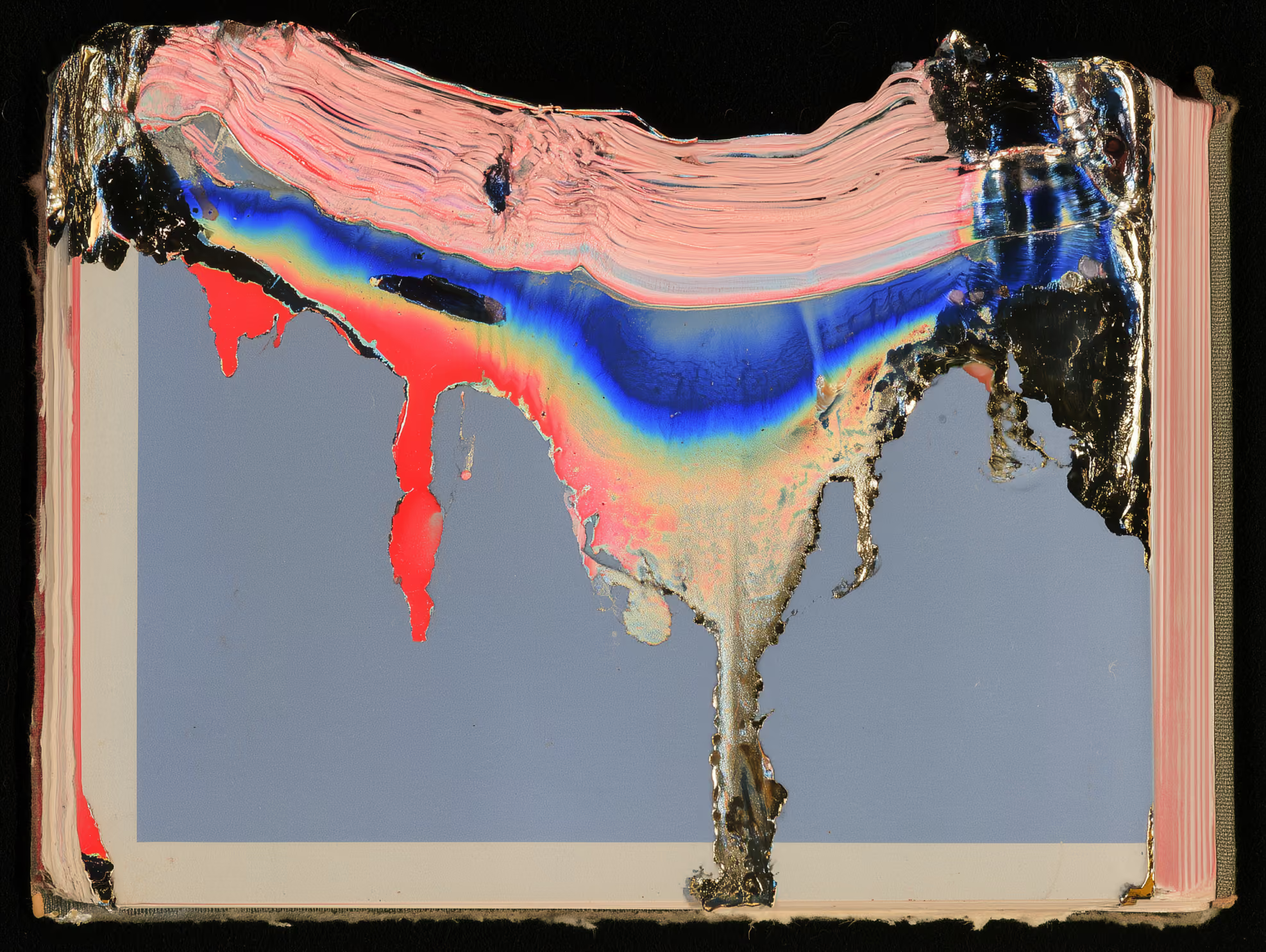
This venture might have meant the destruction of some books that are now sealed forever in a private company's data stores, and maybe the worst part about it is that we’ll never know.
Those books live on in digital form, sure, but so does everything the libraries, universities, and museums digitized on microfilm in the 20th century, which only lasts 500 years under perfect conditions…and still requires specialized equipment to read. (The important film Bladerunner 2049 reminded us of this.) How much longer will those things be truly accessible?
And maybe the most important question: who will control it? That’s what The Book Dealer feared most about this situation, saying, “I guess the one thing that I’m worried about is the aspect of information control, rather than information gathering. If physical books are recreated in the ersatz, the information can be easily changed and manipulated. And with the physical copies themselves destroyed, with nothing for reference, the influence of these companies can be even greater. History is always being rewritten, and this, to me, feels like a very efficient way to gaslight en masse.”
Maybe the book lovers are overreacting, and it was all just deadstock of thriller novels that got destroyed and scanned. No big deal, you can get as many as you want at the nearest airport, right?
It’s just that we’re all big readers, so things like this line from the 1983 novel Pilgermann come to mind, as it did to The Book Dealer:
Happy reading!