.avif)

.avif)
AI-CYCLOPEDIA

Tools like ChatGPT and Claude don’t form in the void. People created them, building platforms you hear about almost every day in the news…usually accompanied by a new scandal:
- A founder’s weird secret society
- Another economic doomsday scenario
- A public spat with a sitting U.S. president
With so much changing so fast, it’s hard to keep up, so we’ve gathered some of the major recent headlines and controversies to create this list.
Major Players
Don’t hate the player, hate the…Okay, hate some of the players.
Anthropic, which developed the Claude LLM family, was founded by exiles from OpenAI in 2021 as a public-benefit corporation with a focus on AI safety.
Despite being the first frontier AI lab with products approved for use on classified U.S. networks, the company was embroiled in a heated dispute with the government earlier this year over its objections to the use of its tech in domestic surveillance and weapons systems.
One Pentagon official even accused CEO Dario Amodei of having “a God-complex” and trying to control the U.S. government by limiting the usage of Anthropic’s technology, but Amodei refused to back down and allow unrestricted use.
This prompted the Trump Administration to threaten Anthropic by labeling it a supply-chain risk in February 2026, with the U.S. Department of Defense (DOD) formally issuing the designation in March. Notably, this marks the first time the U.S. is known to have used the phrase to describe an American company, prompting government agencies and suppliers to stop using Claude.
Anthropic sued the government in response, while OpenAI signed the government contract vacated by Anthropic. Driven by this and other controversies surrounding OpenAI, consumers flocked publicly to Claude to express their support for Anthropic’s stance.
Anthropic’s government woes continued into spring, with public access to its recent Claude Fable 5 model restricted just three days after launching, even after it enhanced its safety guardrails ahead of the public release. Fable 5, a Mythos-class model Anthropic declared “safe for general use,” has since been restored for public access.
Then, in summer, the embattled AI company re-entered the public discourse when unsealed court records from a copyright suit showed Anthropic was destructively scanning rare books to train its models. The process, which involves scanning and then destroying the physical copies of books it acquired, qualified as “transformative use” under U.S. law instead of straight piracy, a minor victory for the company in an otherwise very expensive (read: $1.5 billion) lawsuit. Despite the bad press, Anthropic is only one of the AI companies engaged in this practice, which is widespread.
Anthropic is associated with Dario and Daniela Amodei:
Anthropic’s founders include Dario Amodei, the former Vice President of Research at OpenAI, and his sister Daniela, the former Vice President of Safety and Policy.
The Amodei siblings left OpenAI in 2020 to found Anthropic with other industry leaders, citing a breakdown of trust at OpenAI and a desire to offer a safe alternative. They’ve since grown the small frontier lab into a major competitor.
Dario Amodei’s political troubles include a leaked internal memo that lambasted the Trump administration, prompting a public apology from the CEO. He’s an active political donor, making a seven-figure donation to a super PAC called Public First that supports political candidates backing AI regulations. (He’s also donated to support Democratic candidates, including Kamala Harris.)
Amodei hasn’t shied away from predicting workforce disruption caused by AI, calling it a potential “white-collar bloodbath,” though lately his tone has softened.
Gemini’s name reflects the combination of the two Google research labs whose united efforts gave rise to its new AI technology. (Gemini means “twins” in Latin.)
The resulting LLM family natively processes not only text, but also visual and auditory inputs, a feature known as multimodality. This feature helps Gemini grasp nuances that other models miss when they must first translate inputs into text, thereby causing a loss of context. Google has integrated this AI into its products — including Google Search.
You may have noticed this already. Take the following screenshot:
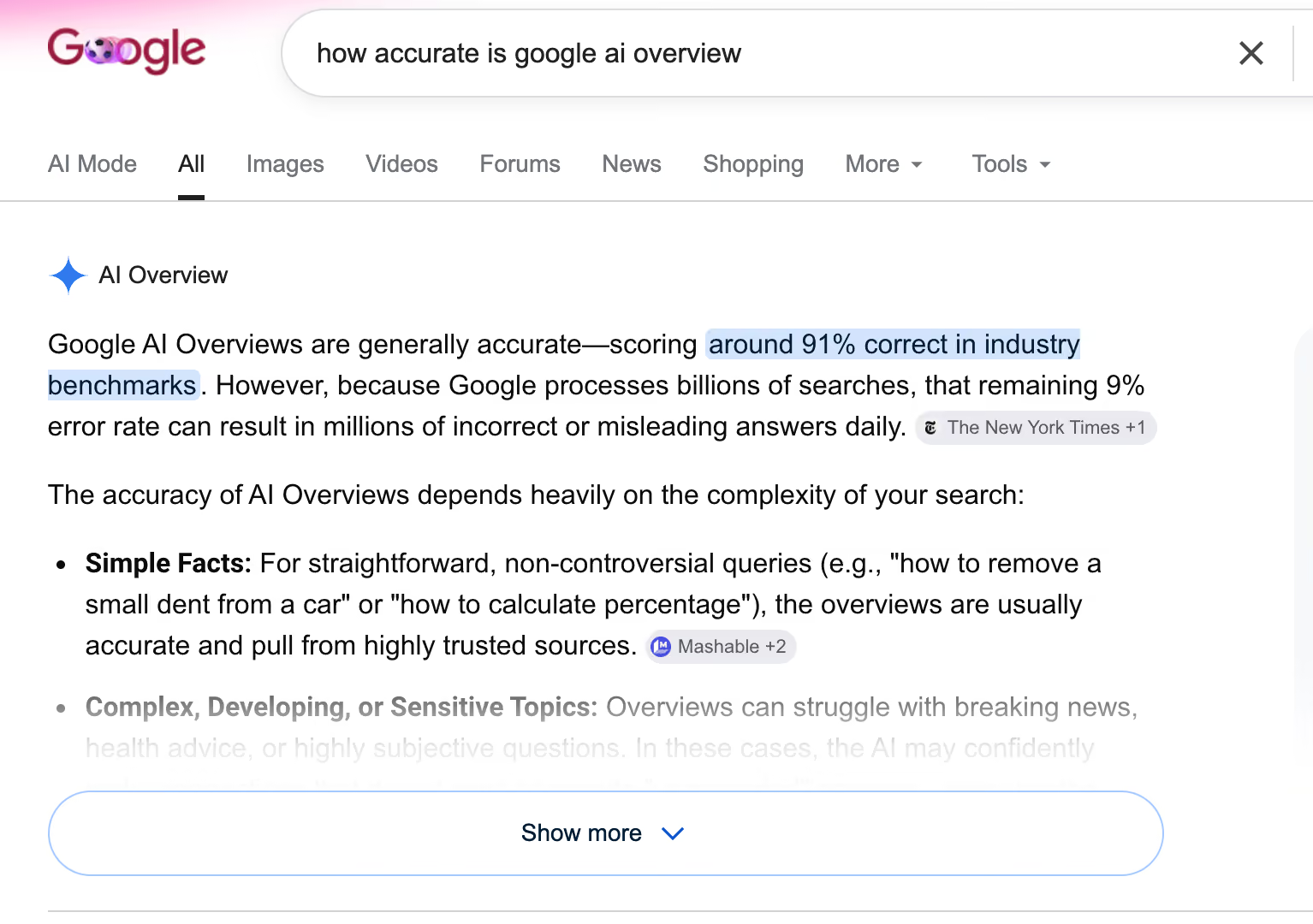
AI Overviews are now the first results for any search query.
Google generates these overviews by using Gemini in combination with its legacy search and ranking systems, synthesizing information found across the web and spitting it out in a neat summary that many don’t scroll past.
Not everyone is on board, of course. User habits vary, and with more than 25,000 people agreeing with a Google Community post lambasting the feature before the post was locked, there is very public evidence that opinions are…mixed.
Despite this, no one can argue that AI search has fundamentally changed how people browse the web, with website clicks down due to summaries and business owners scrambling to keep up. The question of how to dominate AI search has kicked off a gold rush among marketers, with GEO as the next frontier. With few widely accepted answers, it’s a buyer-beware market for advice.
Google is associated with CEO Sundar Pichai
Under Pichai’s guidance, Google expanded into AI, cloud computing, and hardware, like the Pixel line of phones. In a career filled with highs like the successful launch of Chrome, he’s also weathered his fair share of scandals and storms.
Pichai came under fire in 2024, when Gemini generated inaccurate and offensive responses, calling the results “unacceptable” and calling for an overhaul of Google’s AI production processes.
Then, in July of this year, a petition with more than 4,500 employee signatures was delivered to Pichai’s office, demanding worker protections against AI-driven layoffs in an era of record profits, a strong signal from Google’s employees about morale in the wake of tech sector disruption. The press conference held by the employee union cited 2023’s mass layoffs, featuring a chant of “Google, Google, you can’t hide, we can see your greedy side” by employees. Pichai offered no comment.
And Timnit Gebru:
Google’s star AI ethics researcher announced her firing via Twitter in 2020 following a falling out with her then-employer. At the heart of the issue was a paper she co-authored that detailed the risks posed by LLMs, including the possibility that they might simply mimic text without understanding the material. Gebru coined the term “stochastic parrot” to describe this phenomenon.
During discussions surrounding the paper’s publication, Gebru also sent an email detailing her frustration about the company’s diversity efforts, which was later interpreted as one of the reasons for her dismissal.
Her stance inspired industry-wide protests against corporate censorship and bias, with more than 1,000 Google employees signing a letter of support for her after her firing.
She went on to found the Distributed Artificial Intelligence Research Institute (DAIR), an independent organization focused on serving communities and increasing diversity in AI research. In 2023, she was named one of Time’s Most Influential People in AI.
You know Meta from Facebook, Instagram, WhatsApp, and Threads, but this corporate juggernaut is constantly expanding. So it was only a matter of time before it set its Ray-Ban-covered gaze on this new digital horizon, developing Llama to power Meta AI. But it hasn’t been smooth sailing.
The social media giant landed on users’ shit lists in July of 2026 after its AI-powered Muse Image generator allowed users to generate images using others’ publicly available account photos.
Users were automatically enrolled with no warning, and an opt-out process was required to stop the program from pulling available photos. The instant backlash caused Meta to walk the feature back just days after its release.
But July wasn’t done with Meta. That very same month, the company was rocked by a lawsuit filed by former employees alleging that Meta used AI to tag and prioritize employees for layoffs who took family or medical leave or had disability accommodations. The suit is currently working its way through the courts, but it isn’t a good look. Meta has released a statement saying the suit’s claims “lack merit.”
OpenAI is an American AI company whose release of ChatGPT in November 2022 sparked public interest in generative AI.
Formed by a group that included Elon Musk and Sam Altman, OpenAI purported to create an open, nonprofit resource for the public to act as a counterweight to big tech companies like Google. (The company has since transitioned to a capped profit structure supported by investors like Microsoft.)
Lawsuits plagued the company throughout 2023 and 2024, with authors and media companies whose work was used to train some of OpenAI's products claiming copyright infringement. While critics also raise questions about safety, governance, and economic fallout, an OpenAI report in late 2025 estimated there are over 700 million active users, with concerns failing to slow public use or interest in the product.
OpenAI is associated with Sam Altman:
One of the most influential voices in tech, Altman, an American entrepreneur, was previously associated with Loopt and Y Combinator before co-founding OpenAI in 2015. After becoming CEO in 2019, he oversaw the development of major AI models such as DALL-E and ChatGPT, which are widely credited with mainstreaming AI.
Altman remains a major investor in the tech scene, with equity in Reddit, Instacart, and more. While his supporters credit him with making AI technology widely accessible, he’s been dogged by allegations of misconduct, including a brief ouster as CEO in 2023, which was resolved after an outpouring of support for Altman from employees and investors, leading to his reinstatement.
Palantir Technologies builds for institutions, not individuals, with its software sitting far outside the tech stack of your average user…but not outside the news they read. Its reputation as a modern-day bogeyman harkens back to its creation as a CIA-funded data-mining tool.
CIA support provided the launch platform that rocketed Palantir to its current status; it now serves global governments and multinational corporations. Its products’ capabilities for pattern recognition within massive datasets have been deployed in widely criticized U.S. immigration enforcement activities, global military operations, and more.
Its polarizing reputation — despite soaring stock prices and surprisingly okay Glassdoor employer score — isn’t helped by its founders, including controversial figures Peter Thiel and Alex Karp, and detractors cite concerns about privacy and surveillance.
Palantir’s very name evokes a dire warning. It’s a reference to the Lord of the Rings author J.R.R. Tolkien’s palantír: crystal balls that allowed viewers to communicate with others using the stones or to witness events that may or may not come to pass (and they were notably used by The Bad Guys). Tolkien used the palantír as a caution against speculation. Founders seemed to take this as inspiration.
Proponents view Palantir's technology as a critical asset for democratic defense and counter-terrorism, and the company itself says it doesn’t harvest or sell personal information; it just helps large institutions analyze and make sense of existing, lawfully collected data.
Palantir is associated with Peter Thiel:
Peter Thiel is a co-founder, initial financier, and longtime chairman of Palantir Technologies. He remains a major shareholder, owning a substantial stake in the company.
Thiel kicked off a debate over free press and the influence of the billionaire class on public discourse when he retaliated against Gawker Media for publicly outing him in 2007, secretly spending $10 million to bankroll lawsuits (including Hulk Hogan’s 2016 Invasion of Privacy suit) that forced the company into bankruptcy.
A prolific conservative donor, Thiel’s own views have been described as hostile to democracy. His most recent controversies include a closed-door lecture series in Rome on the Anti-Christ that prompted the Pope to express “concern,” and the leak of information about his “secret” high-society group, Dialog.
And Alex Karp:
Recently, Palantir co-founder and CEO Alex Karp has drawn widespread criticism for a manifesto based on his book, The Technological Republic. In it, he calls for mandatory national service, rejects pluralism, and predicts a new age of AI-based deterrence.
Alarm over the document’s aggressive tone stems from Palantir’s influence through its numerous public-sector contracts, with one UK politician calling the post “the ramblings of a supervillain.” But it’s not the first time Karp’s public comments have put him in hot water; he’s infamous for a CNBC interview implying AI will have particularly negative effects on women’s economic and political standing.
Elon Musk’s efforts at global — and beyond — domination include a foray into AI, founding xAI in 2023, and integrating it with the social platform X, formerly known as Twitter.
xAI is responsible for the image generator and chatbot Grok, which might be one of the most prolific pornographers in human history, generating millions of sexualized images of figures both real and imagined, in many cases without the explicit consent of the subject.
You can read more about explicit deepfakes from Chronically Online Magazine in Artificial Exploitation.
Horrifically, its capabilities include the potential to create child sexual abuse material (CSAM), though xAI has recently attempted to shift responsibility for this to the end user by filing a lawsuit against users who violate the terms of service by generating this type of material.
Musk hasn’t shied away from Grok’s spicy capabilities, positioning it as an “anti-woke” alternative to chatbots like ChatGPT; however, Grok has been forced to undergo retraining in the past for comments that praised Adolf Hitler, drawing ire from international governments and citizens alike for its hateful output.
xAI is associated with Elon Musk:
Musk himself is no stranger to accusations of hate speech, with his response to the election of Donald Trump to the U.S. presidency having been widely panned as a fascist salute, a claim Musk refuted.
In defense of his often-controversial statements, Musk says he identifies as a “free speech absolutist,” though critics have pointed out his actual behavior only upholds the speech he seems to agree with.
Musk donated more than $280 million dollars to influence the 2024 election, becoming the biggest single donor to the cause and taking an early public, though unelected, role in the resulting administration. His short-lived stint as the head of DOGE further negatively affected his public reputation, leading to what many characterize as a retreat from public life.
This article will be updated periodically.