.avif)

From Plain Text to Subtext

Reading used to be a lot harder. Like, a lot a lot.
Materials were hard to produce and access before the Age of Amazon, and my fellow former The Egypt Game fans, we *cannot* simply put aside the fact that you and I likely wouldn’t have been born into the literate class.
But let’s say you won the genetic lottery back in the day. Even as a member of the scribal, priestly, or royal social castes, ancient written languages were just plain harder to understand.
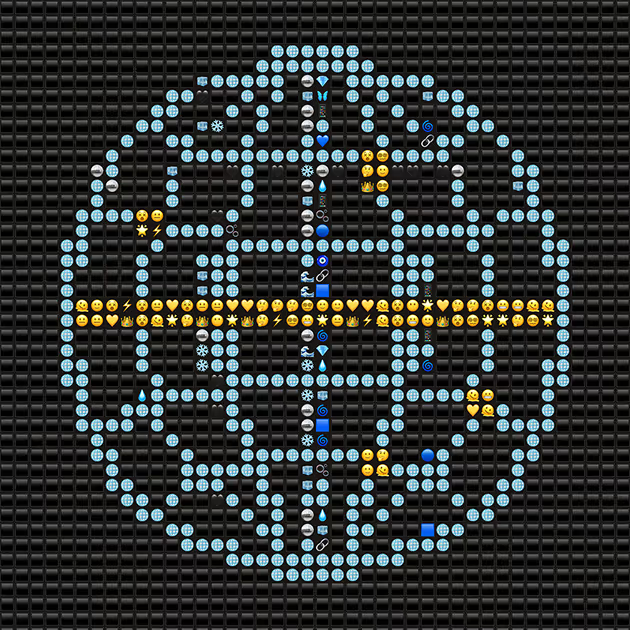
Alphabets were different; the modern 26-character set we English-speakers learn as children is undoubtedly much simpler than the hundreds of symbols comprising hieroglyphics. Characters themselves could also change meaning depending on nearby symbols, adding layers of necessary understanding.
(In fact, there were ultimately three different character sets and around 1,000 characters; ancient Egyptian was a sophisticated and complex mode of communication.)
We also can’t put aside cultural differences in behavior and expression.
Not All Languages are Created Equally
Languages like Egyptian and Sumerian are considered high-context. High-context languages rely on a shared understanding of history and cultural norms to shape the meaning of characters and words.
These languages are generally more difficult for outsiders to parse than, say, English, which relies on clarity and directness and falls into the low-context category.
American Anthropologist Edward Hall, Jr. introduced the concept of high- and low-context cultures in his book The Silent Language. Hall posited that cultures varied in members’ need to read between the lines, with high-context cultures supporting in-group social cohesion and helping to manage group dynamics.
The designation is flexible. For example, Southern American English relies somewhat on cultural understanding to convey meaning. (For those unaware, “Bless your heart” is not actually a benediction.)
Languages, though, are living things — even low-context ones. And the Internet, that Great Disruptor, has fundamentally changed so many aspects of our culture that it’s impossible to imagine something as basic as communication has escaped; in fact, some circles have even started debating whether Internet practices are changing English from a low- to high-context language.
Just Add Pictures
Take the humble emoji.
The 🍆 doesn’t belong on your grocery list. If you didn’t know that (let’s generously assume you’ve been too busy to Internet, or took a multi-year sabbatical on Mars), and texted the following to your best friend, that friend isn’t going to assume you’re making eggplant parmesan:
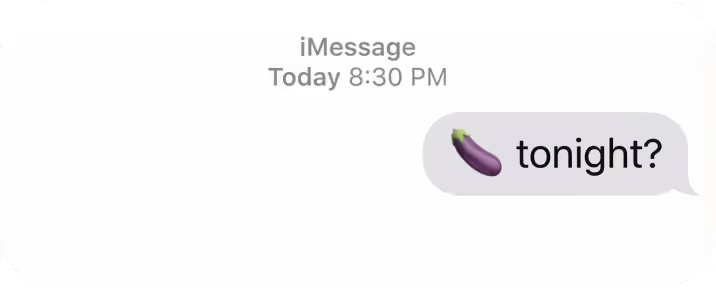
In fact, its today-meaning is so ubiquitous that the purple emoji was officially banned from Instagram search in 2015. These days, you can still actually use it in posts, but only if you’re talking about a recipe. Instagram’s Community Standards formally banned 🍆 in sexual contexts in 2019, with content that "implicitly or indirectly (typically through providing a method of contact) offer[s] or ask[s] for nude imagery, or sex or sexual partners, or sex chat conversations," subject to removal.
The 🍑 and 💦have similar implicit, explicit meanings, so maybe avoid using 🍑 to ask your mom about making peach pie.
(Low-hanging fruit, we know).
But does this really mean we’re evolving? Not so fast.
Experts Weigh In
Keith Broni is the Editor-in-Chief of Emojipedia.org, the largest online reference resource for emoji. Part emoji library, part encyclopedia, you can use it to copy/paste various emojis into your text and learn their origin and context.
You might say he’s close to the issue.
Broni, who has an MBA from Quantic and an MS in business psychology from University College London, oversees Emojipedia’s editorial work and leads analysis of the latest academic research in the emoji space and all company-wide data. He’s also Emojipedia’s Product Manager.
“I’m not sure that what is happening with emojis, or indeed Internet-speak, is a fundamental change in how we are using our language,” he said.
Broni cited social media research indicating that the source of social-speak is not our formal, written language but our everyday speech patterns.
When we’re writing a post, he explained, what we’re usually trying to do is speak casually. But whereas face-to-face communication can include explicit paralinguistic markers, such as facial expressions and gestures, that convey tone, text-based communication lacks these emotional signifiers.
“That’s when emojis have been introduced,” he pointed out, “to add clarity.”
In fact, he said, they could be considered more of a low-context tool if anything, because they keep emotional expression explicit.
“The vast majority of them are still taken at — pun intended — face value.”
Generational Splits Affect Usage
But while a thumbs-up emoji might mean one thing to one group, it might mean something completely different to another.
“Emojis sit on a sliding scale of universality, where a lot of the facial expressions you would look at and go ‘I know what that means!’ but over time, new interpretations have been introduced, even with the smileys,” Broni said. “Over time, certain generations between Millennials, like myself, through Gen Z have looked at certain smileys and gone ‘That’s maybe not positive enough,’” implying the user was just trying to seem polite, but didn’t genuinely mean it.
Broni gave the example of the slightly smiling face (🙂).
“A lot of people construe that as being passive-aggressive,” he said. “While it is, on its surface, a positive facial expression, given how bombastic a lot of the positive facial expression emojis can be, it seems to be implying that the person has gone for the most simple version.”
And that sends a message. What that message really is might depend on when you were born, though.
“That doesn’t hold true for all uses of that emoji. In particular, we see that younger generations feel that this is passive-aggressive, as opposed to Millennials and older generations using it much more literally,” he said.
Same as the thumbs-up emoji.
“I’m sure you’ve seen throughout the years so many thinkpieces on ‘Is the thumbs up emoji cancelled now? Is it passive-aggressive now?’ The answer is: it can be both. It all depends on who you’re speaking to and then the context in which you are speaking to them.”
Broni says younger generations won’t use it literally “unless they’re speaking to people from older generations,” an instance in which said kids feel like they’ll be able to use it to clarify their own message better.
Essentially, they’re code-switching: changing their communication mode to fit in.
So, Have We Really Evolved?
“The way that emojis are operating today is very similar to how slang always operated,” Broni explained. “That doesn’t mean that the English language has gone from low-context to high-context, but certain registers are contextual. Things in the casual register are very contextual, and we’re just able to see that on a global scale now, like never before with the advent of social media.”
And while the culture at large may not be shifting, the internet is proliferating subcultures.
“You’re having communities of people that have shared interests able to completely subvert geographical distance and communicate with one another,” Broni said.
Fandoms, interest groups, you name it. Thanks to the Internet, more people with niche hobbies are more connected than ever before, allowing these groups to grow and develop their own slang and cultural touchstones.
“We’re seeing communication styles that would have only existed in speech or written in very, very specific contexts be publicly accessible to anyone,” he said. “The globalization of communication has led to an absolute explosion in context-specific remixes of terms and terminology, and of course, emojis.”
It may not be a shift towards a more contextual mode of communication — but it’s something.