.avif)

If Social Went Down, Would You Survive?

At 11:51 a.m., October 4th, 2021, Facebook, Instagram, and WhatsApp went down simultaneously. Gone. No error message that made sense, no ETA, no adult in charge. For six hours, three of the most widely used applications in human history were kaput. No one had their skull chewed on. Remember when Instagram went down, like that Saturday Night Live skit when the teleprompter went offline, and the news anchors didn't know what to do? Will Ferrell ate his co-worker's head. That's what you call quality programming.
People went to Twitter to freak out. They went to Reddit to confirm it wasn't just them. They texted people they hadn't texted in months, not because they had anything to say, but because the absence of one channel made them lunge for another.
The phone calls were the tell. People actually called each other. Caught up. Some hadn't heard each other's voices since before the pandemic. A few later described the outage as almost peaceful, which is the most damning possible endorsement of what we'd built our lives inside of. Facebook, Instagram, and WhatsApp — platforms used by over 3.5 billion people globally. Americans check their phones over 90 times a day on average. (And now I hate myself for that stat.)
Meanwhile, inside Facebook's campus in Menlo Park, engineers couldn't badge into buildings because the door systems ran on the same network that had just collapsed — whoops. They were locked out of the servers they needed to access to fix the problem. Mark Zuckerberg lost seven billion dollars before dinner. The stock dropped 9%. Internal communication tools went dark. They were reportedly using email like animals.
The cause? A routine maintenance command. It disconnected Facebook's data centers from the internet, and a cascade of failures made it nearly impossible to regain access. The machine had swallowed its own key. Six hours later, the lights came back on.
For one long afternoon, the nervous system lost signal. What people did with the silence — who they called, where they went — said more about where we are than any of the op-eds that followed. But what does the internet look like in the middle of nowhere? That actually happened. And the results were telling.
%20(1).avif)
How to Survive Unplugged
While we were busy debating whether we could survive without it, a community deep in the Amazon got its first WiFi and figured out the answer in about a week. CNN's Nick Paton Walsh — Chief International Security Correspondent, multiple Emmy winner, and self-described non-fan of social media — embedded with activists bringing Starlink to the Kanamari people, an indigenous community where the protected lands of Brazil meet the borderlands of Peru. What he found wasn't a utopia of connectivity. "We were taken aback by how fast these communities realized the damaging nature of the internet on their lives," Paton Walsh said. "Yes, the jump from their time-honored ways to an online world was huge. But they wasted no time in realizing there had to be an off button to keep their kids safe — something the urban world doesn't really see yet."
A community that had never been online figured it out in a week. The people who built the thing needed 20 years. And they're still not done pretending.
On one hand, you've got the endless doomscroll machine informing you of everything that's wrong with the world. On the other hand, you're informed enough to fight it. But with all the influencers and political arguments comes the part nobody wants to say out loud: we are hooked, and the hook is load-bearing.
The Stakes are Different for Creators
The lazy take is that we're all addicted and need to touch grass. Sure. For the average person, there's always a walk, a TV, and other humans. But if you're a creator, social media is the entire architecture of how you make a living, find customers, and build an audience — an outage isn't an annoyance. It could screw up your whole career. A mid-tier influencer loses clicks and cash. A small business running its entire customer acquisition through Instagram goes dark. Someone's launch day is today. The platform didn't go down for everyone at the same time. More than 50 million people worldwide now identify as creators, many of whom rely on Instagram as their primary source of income. If Instagram or TikTok goes dark, the disruption isn't abstract — it's rent.
Lani Rosales knows exactly what's at stake. She runs the Austin Digital Jobs Facebook group, a collective dedicated to helping people in Austin find a new gig, which in this economy is no small task. "I would take a major financial hit," she said, "but I've been building our email lists juuuuust in case." That "juuuuust in case" is doing a lot of heavy lifting. That’s fear gussied up as a strapless-backed contingency plan.
Social media is civic infrastructure now in a way it wasn't ten years ago. Crisis communication, small business discovery, community organizing, local news replacement — it all runs through these networked pipes. The question of survival stopped being personal a long time ago.
What About the Normies?
Still, when you ask regular people, they answer flatly: they couldn't care less if it disappeared. I asked on Facebook — and yes, I understand the irony. The majority were 30-plus, meaning many are Millennials who've lived long enough to be jaded about pretty much everything, including the platforms they're still logging into every day. (Hello, it’s me you’re looking for, as Lionel Ritchie says.)
Lauren Jacobs cut through the whole conversation in one line: "Yes? I did a whole 27ish years without telling strangers when I'm not at home, and exactly what I'm doing and what I think about anything. Blah."
Which is either the healthiest perspective in the room or the most exhausted one. Probably both.
"I would have mixed feelings. I have no family that live near me, so it's nice to have small opportunities to see how they are and interact more casually. I also have object permanence issues, so without seeing people, I basically forget they exist unless something triggers it. On the other hand, I would love for it to be gone — it would force more real connections, and the infinite push of nonsense being gone would be lovely."
The pile-on didn't stop.
"I've utilized social media in innovative ways to market my music, my writing, being a bartender, and now a hairdresser. If it all went away tomorrow, I'd have to pivot — but I would survive, because I'm a survivor, and I'd arguably end up being more successful because I would waste less time scrolling."
Over 30 people said something along the lines of: they'd be better off without it. "I would survive, but there are definitely several people in my circle I feel like I'd never see or talk to again." And: "I think I would definitely go through a withdrawal, but it would be a million percent healthier for me if it disappeared."
"I just wouldn't know what a bunch of 'friends' were up to. Then again, if you're a friend, you have my number, and we stay in touch for the most part." And so it goes. One minute you're meeting drunk in a bar and agreeing to follow each other. 15 years later, you're internet homies.
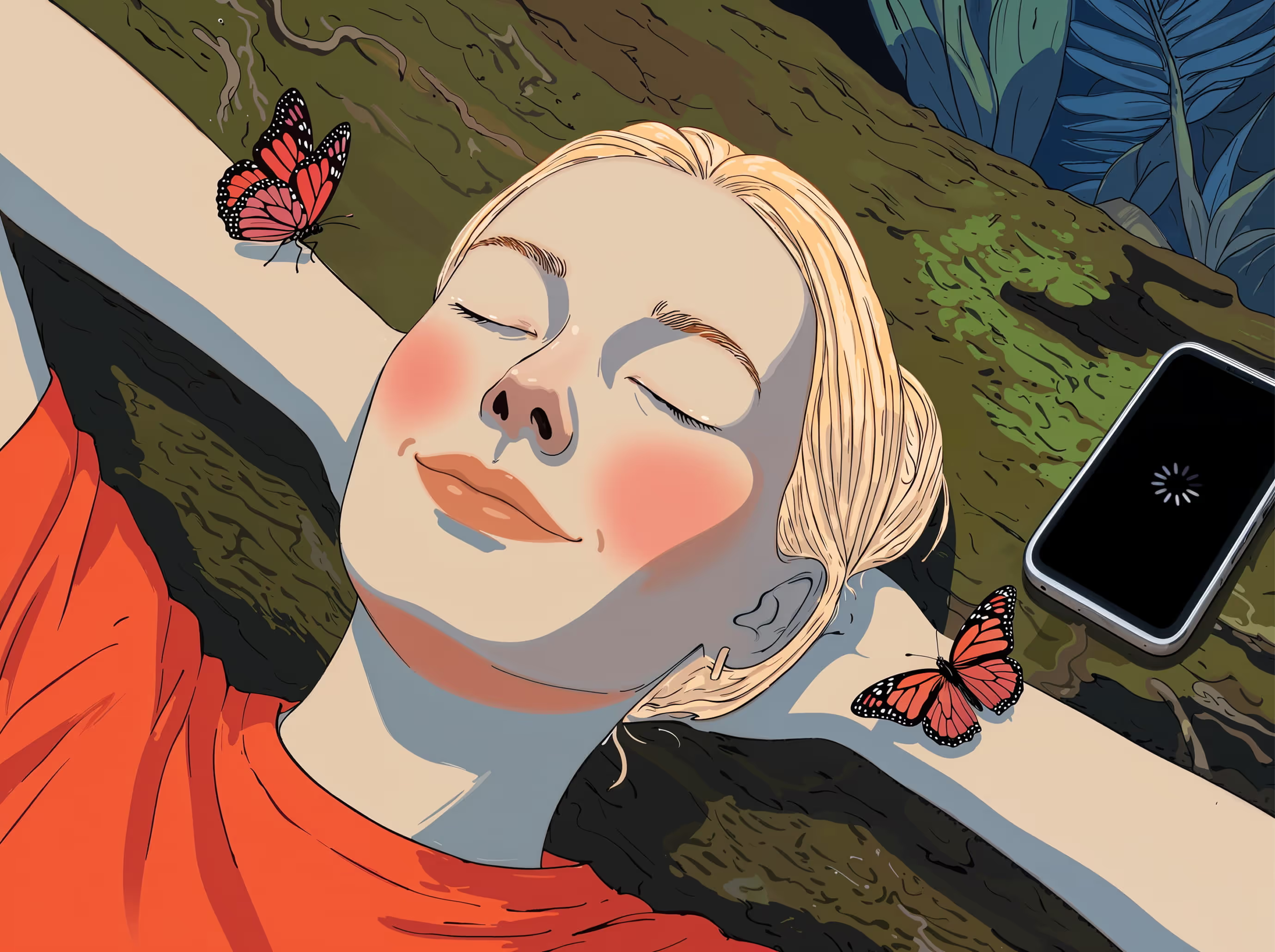
Push the (Off) Button
I'll be honest — I work for a company that lives inside these platforms and helps creators build their whole operations on them. I'm not a neutral party.
But I'm also the guy who fantasizes about a world that looks like Paris in the 1950s, where the conversation happened in the room, and the only algorithm was the bartender deciding when you'd had enough absinthe. The fact that both of those things are true about me is probably the whole story right there.
That's the thing. We built all of this, and we never installed the off button. We told ourselves the feed was neutral, the algorithm was just math, and the dependency was a personal failing rather than the intended outcome.
It wasn't. It was the product.